Managing several apps and social platforms can quickly become complicated. People often move between different dashboards, copy information from one service to another, and keep track of multiple accounts at the same time. This has created growing interest in tools and concepts designed to bring digital workflows together.
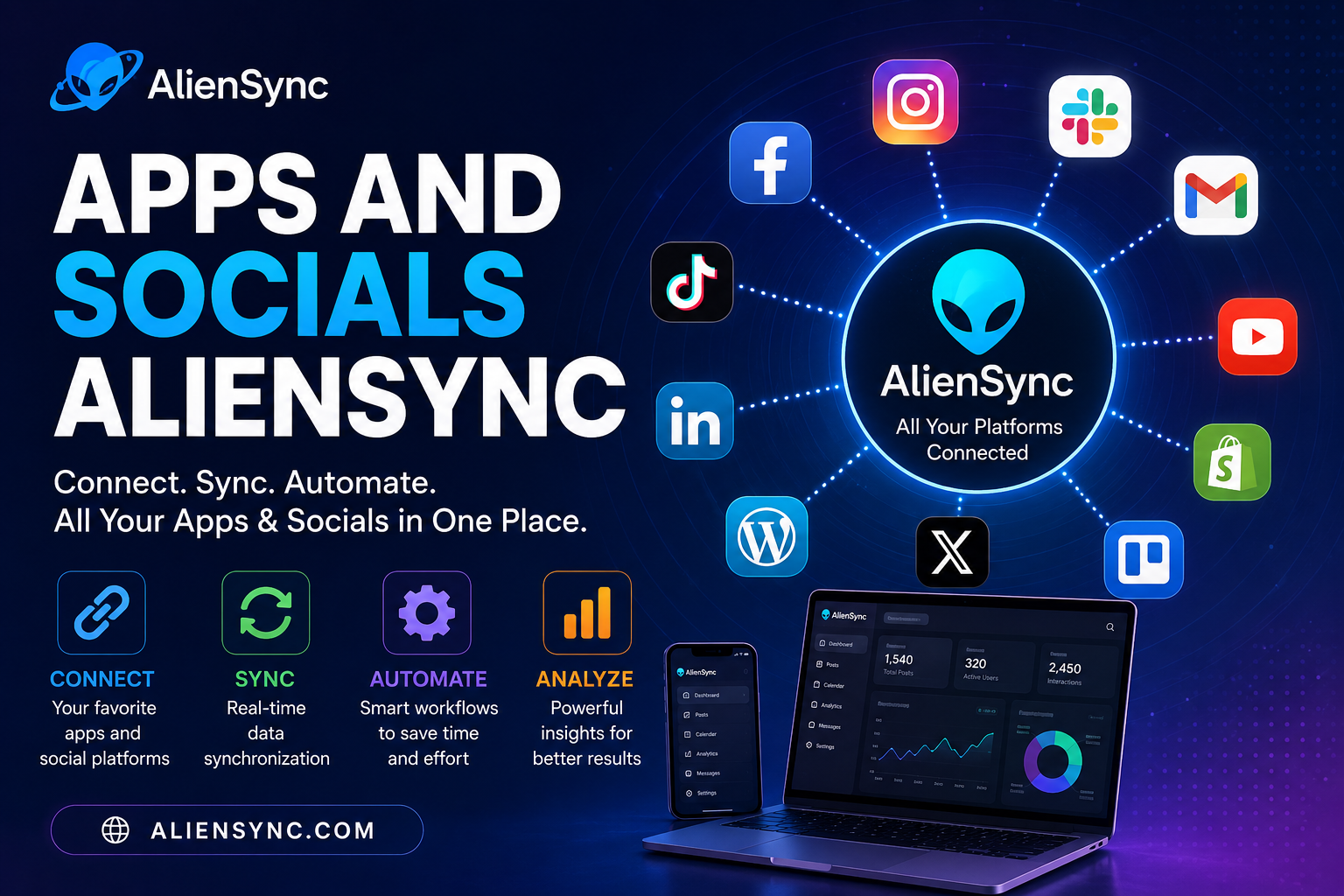
The term apps and socials AlienSync is associated with AlienSync’s technology-focused content and its broader idea of connecting applications, social platforms, and software through synchronization and automation. For readers exploring the subject, the apps and socials AlienSync website provides articles covering social media, software, integrations, digital trends, and related technology topics.
Understanding Apps and Socials AlienSync
At a basic level, apps and socials AlienSync describes an approach to connecting different parts of a digital workflow. Instead of treating every application as a completely separate environment, synchronization concepts aim to allow information or events from one system to influence actions in another.
AlienSync currently presents itself primarily as a technology and editorial platform, while its articles also describe a conceptual synchronization framework for apps, social accounts, and business software. This distinction is useful because readers should separate published concepts and workflow examples from independently verified software capabilities.
The broader idea is straightforward: when digital tools can communicate effectively, users may spend less time repeating routine tasks and more time concentrating on useful work.
Why This Digital Connection Matters
Modern online work often involves several services at once. A business might use social platforms for communication, a project management application for internal work, an analytics system for performance information, and customer-support software for incoming questions.
Without a coordinated workflow, information can become scattered. A social media update may need to be copied into another system, while customer messages might have to be manually transferred into a task list. Synchronization can provide a more organized way of handling these activities.
AlienSync’s published guides discuss this idea through connectors, APIs, webhooks, rules, and centralized dashboards. These are common building blocks in modern software integration, although the exact implementation and availability of particular features should always be checked against current documentation.
Main Features and Possible Uses
One of the most useful ideas surrounding this topic is centralized management. A unified workspace can make it easier to see different accounts, tasks, notifications, or content activities without constantly changing applications.
Social publishing is another important use case. AlienSync’s published material discusses workflows involving platforms such as Instagram, TikTok, X, LinkedIn, Slack, Gmail, and other software services. The practical value of such connections depends on the permissions, APIs, and integrations actually available for each service.
Automation can also be helpful. For example, an organization could design a workflow in which an event in one application creates a task or notification somewhere else. Instead of manually checking every platform, predefined rules can help route information to the appropriate destination.
Managing Social Platforms More Efficiently
Social media management is one area where synchronization concepts can be particularly useful. Businesses and creators may have several profiles that require regular attention, including publishing, monitoring comments, responding to messages, and reviewing performance.
The AlienSync social and software resources discuss centralized social workflows, content synchronization, automation, and analytics as important parts of the broader concept. The goal is not simply to put everything into one screen, but to create a workflow where each platform has a clear role.
For example, a marketing team could prepare content in one workspace, coordinate approvals internally, and then distribute approved material through appropriate social channels. This can make the process easier to follow, especially when several people are involved.
How People Can Approach AlienSync
Anyone researching apps and socials AlienSync should begin by identifying the actual problem they want to solve. Is the main challenge managing multiple social profiles, organizing notifications, connecting business software, or reducing repetitive work?
After identifying the problem, users can examine which applications need to communicate and what information should move between them. Starting with a small workflow is usually more practical than attempting to connect every available service at once.
Security should also be considered from the beginning. Social and software integrations can involve account permissions, authentication tokens, customer information, or other sensitive data. AlienSync’s published integration guidance recommends carefully controlling permission scopes and reviewing access regularly.
Related Digital Trends
The interest in connected applications reflects a wider shift in digital work. Companies increasingly use cloud services, communication platforms, customer databases, analytics tools, and social networks together.
Automation is also becoming more common. Rather than manually repeating predictable actions, users can create rules that respond to specific events. APIs and webhooks make this possible by allowing compatible services to exchange information.
Artificial intelligence is another developing area. AlienSync’s recent material discusses AI-assisted content workflows alongside social scheduling and integrations. However, AI features should be evaluated carefully, particularly when automated content or customer communication is involved.
Why Online Information Matters
Technology platforms change quickly. Social networks update their APIs, applications introduce new features, and integrations can gain or lose compatibility. Because of this, online research is important when evaluating any synchronization tool or workflow.
Readers can use technology-focused publications such as Topical Magazine to explore broader digital subjects, software developments, and practical online trends. Comparing information from several reliable sources can help users understand what a technology actually offers instead of relying only on promotional descriptions.
It is equally important to distinguish between an established product feature and a conceptual example. AlienSync’s own recent guide notes that some descriptions represent integration ideas rather than verified public APIs or SDKs. This makes careful research especially valuable.
Future of Apps and Socials AlienSync
The broader future of apps and socials AlienSync is connected to a larger movement toward integrated digital experiences. Users increasingly expect applications to work together rather than operate as isolated tools.
For businesses, better synchronization could mean more organized workflows, fewer repetitive actions, and clearer visibility across digital operations. For creators, connected social workflows could make it easier to coordinate content across multiple channels.
Still, successful integration requires more than simply connecting accounts. Data quality, permissions, security, API availability, platform policies, and reliable error handling all matter. As technology develops, these practical considerations will remain important.
Conclusion
Apps and socials AlienSync represents an interesting way to think about the relationship between social media, applications, and business software. Its published material explores synchronization, automation, centralized management, integrations, and emerging digital workflows.
For readers and businesses, the most useful approach is to focus on real workflow needs rather than simply connecting as many platforms as possible. Start small, understand permissions, verify current capabilities, and expand gradually. With careful planning, connected digital workflows can make online activities easier to organize and understand.